
How AI Changes the Order-to-Cash Value Stream
How the path from a customer's order to the payment in the bank account is automated step by step, plus why the limit here is set by the customer, who can ask for the reason behind every decision.

Sebastian Bitter
9.9.2026
Order-to-Cash carries a customer's order from arrival to the matched payment. It is the counterpart of Procure-to-Pay, with the same structure and the money flowing the other way, which is why its limit sits at a different point. Suntory Beverage & Food Spain stands at the assistive level, where the AI reads orders and customer service checks the exceptions. Danone North America stands at the agentic level with more than 1.1 million deductions a year, for which the software gathers the documents while the analysts decide the disputes. The autonomous level is split. Payment and invoice run fully automatically because they touch only the company's own books. The credit decision and the payment reminders touch the customer. Upstart's annual report shows how control passes into the bank's rules, while the SCHUFA ruling and a Berlin fine show where the limit lies for private customers. Four of the six cases come from courts, regulators or an annual report.
The stream today and where AI takes it
Order-to-Cash runs from the customer's order to the moment the payment has arrived and is matched to the right invoice in the system. Every company that writes invoices runs this stream. It is the counterpart of Procure-to-Pay from the previous post, with the same structure and the money flowing the other way.
In its classical form the work runs as six steps, each carried out by a person and each producing a hand-off to the next. Someone reads the order from an email, a portal or a fax and types it into the system. A clerk checks the credit limit, meaning the amount up to which the customer may buy on account, then releases the order or blocks it. The order is confirmed, the goods are shipped, the invoice goes out. When the payment arrives, the bank statement is matched against the open invoices, by hand wherever the invoice number is missing or wrong. At the end come the reminder runs and the unresolved items. An unresolved item is a payment that does not fit an invoice, because the customer paid less, deducted an amount or disputed a quantity.
The effort arises at the same points as in purchasing, except that the causes sit with the customer. The customer types the order into their own system and the company types it in again, because it arrives as a PDF or an email rather than as data. Payments come as bulk transfers, with deductions or without a usable invoice number, so the matching stays manual. Reminders reach customers who paid long ago, because the matching lags behind. The figures on payment behaviour show how much work piles up at the end of the stream. In Germany suppliers granted their business customers an average of 32 days to pay in the first half of 2026 and were paid after roughly 40 days, while overdue invoices were settled about eight days late. Across Europe suppliers report payment periods of more than 60 days, with more than half of companies reporting difficulties caused by late payment. A supplier can be told which format to use. A customer cannot. The clean data that forms the lever in Procure-to-Pay is therefore only partly in the company's own hands here.
For the same reason the limit of automation sits at a different point in this stream than in purchasing. In purchasing, reading an incoming invoice may be fully automated while releasing the payment stays with a person, because auditors want to see who took responsibility for it. In Order-to-Cash the middle of the stream is the safe part. If the system matches a payment to the wrong invoice, an open item appears in the company's own books and someone corrects it. Nobody outside the company notices. At the beginning and the end of the stream, by contrast, the decisions land on the customer as a refused credit line, a blocked order or a reminder. Where the customer is a private individual, Article 22 of the General Data Protection Regulation applies. It permits a system to take a decision with legal effect on its own only under certain conditions and gives the person concerned the right to have a human step in. The bottom row of the figure therefore shows two steps that run fully automatically today next to two where the law demands a person.
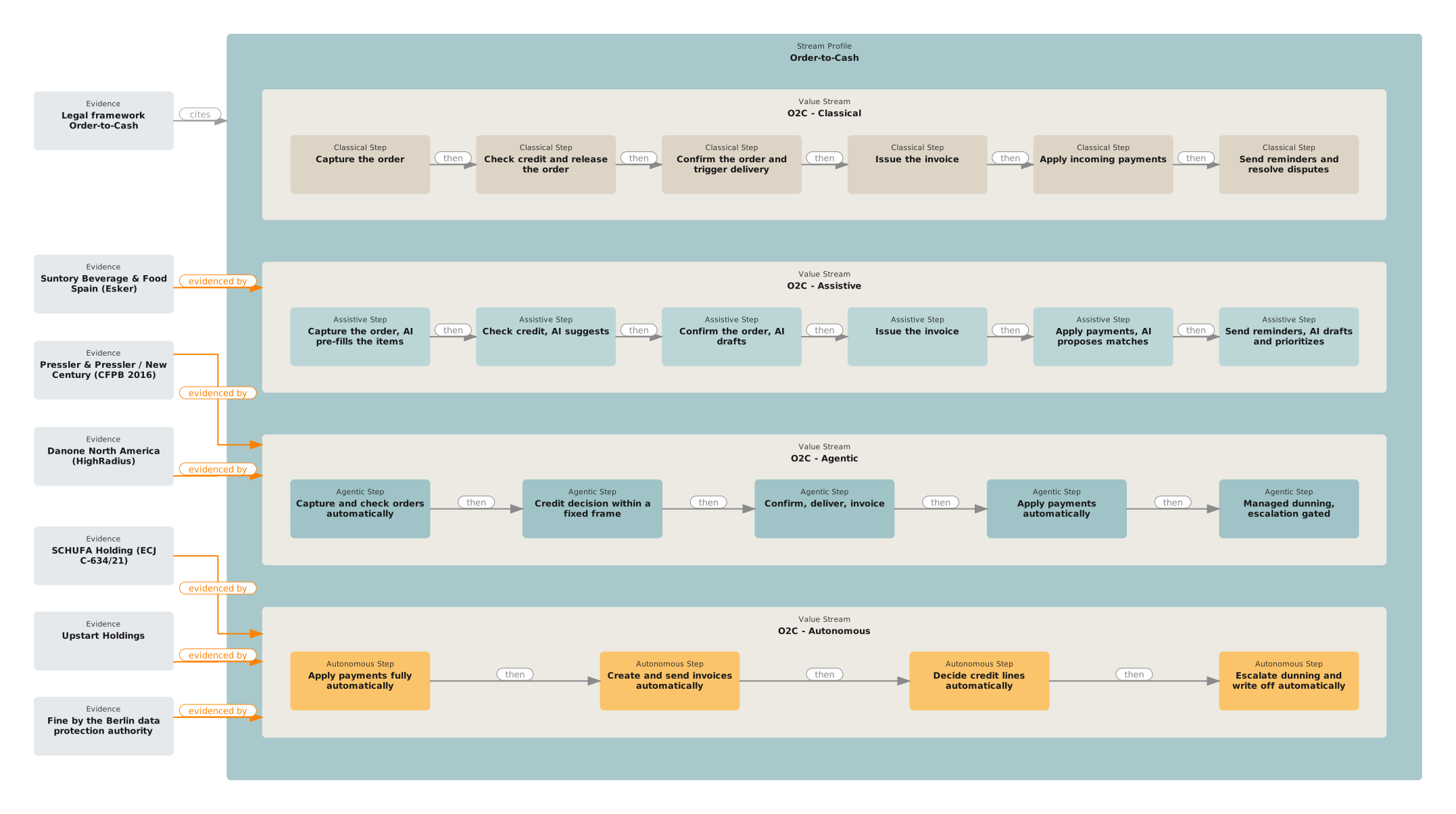
Figure 1: Order-to-Cash across the four levels. Across the four levels the system takes over more of the work and the human is left with the exceptions. Read each row as the same stream at a different level, left to right from order to reminder. The bottom row has four steps, two of which run fully automatically today while at two the law demands a person. On the left sit the six cases and the legal framework this post is built from.
Level by level, shown by real cases
Each level comes with an example, its reported figure and the point where that figure stops holding. The classical level is the starting point described above, with no AI in the flow, so the walk begins at the assistive level.
Assistive: the AI reads the order, the human checks the exceptions
At the assistive level the six steps from above stay where they are, because the AI only prepares work inside each one, which makes this the level that changes least about the organisation. The system reads the incoming order from the document and pre-fills the order fields, it proposes the matching invoice when a payment arrives and it sorts the reminders by urgency. The human checks every proposal and decides.
The example is Suntory Beverage & Food Spain, a drinks producer with more than 1,000 employees and brands such as Schweppes. Its customer service handles around 3,500 orders a month. They arrive through many channels, as PDFs and emails, via distributors and from telephone sales, from Spain and from Portugal. The software comes from Esker, a supplier of automation for order and invoice processes. A neural network reads customer, items and quantities from the document. The system matches them against the master data, warns of unusual quantities and splits an order when chilled and dry goods need separate logistics. Orders from close to 600 customers flow straight into SAP, the company's ERP system, once they pass the checks, while customer service reviews the rest.
Three figures are reported, all from the software supplier's own case study about its own customer and with no independent confirmation. Handling time per order fell from 2.5 minutes to one minute, 3,400 hours were saved in a year and 55.3 percent of orders go through without any correction.
The work has shifted from typing to clarifying, where every remaining case takes more time and more experience than a typed order ever did. Just over four in ten orders still need a correction. Those are the hard ones, with changing units of measure, mixed assortments or a format the system has not seen before. The decision per customer is new compared with purchasing. Direct posting into the ERP system can be switched on for individual customers, so within the same company some orders are still checked by people while others pass with nobody looking. The human decides who belongs where.
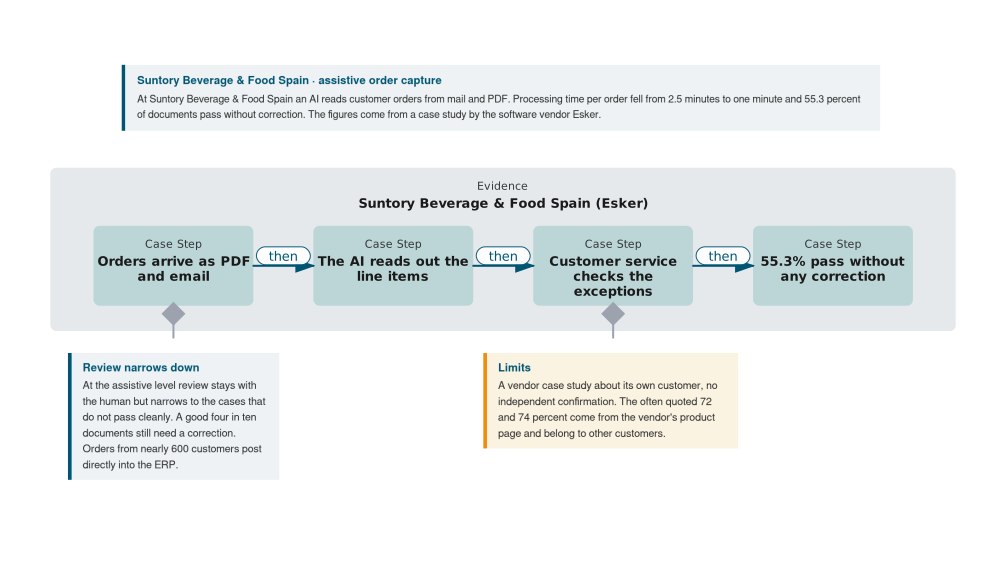
Figure 2: the Suntory case. At this level the human checks only the orders that do not pass cleanly. Read the four boxes left to right as one order on its way from the inbox into the system. The note above summarises the case, the two below mark what stays with the human and where the figures come from.
Agentic: the software gathers the documents, the human decides the disputes
At the agentic level the flow is rebuilt around the automation, so six steps become five and the point where a human intervenes is fixed explicitly. The example comes from the far end of the stream, from handling deductions. A deduction arises when a retail customer pays less than the invoice asks, for a return, an agreed promotional allowance or a damaged delivery. Whether the deduction is justified can only be settled with documents that sit at the customer's end.
The next example is Danone North America, a consumer goods group with more than eight billion dollars in revenue and more than 1.1 million such deductions a year, worth more than 400 million dollars. Before the change, 25.5 million dollars sat in unresolved deductions and a deduction stayed open for 45 days on average. A team of 35 people spent more than 40 hours a week hunting for documents across more than 25 retailer portals, while deductions under 250 dollars were written off without a check. The software comes from HighRadius, a supplier of receivables software. It gathers the documents for each deduction from the portals and attaches them to the case, while the analysts review and decide the disputed ones. The supplier's case study about its own customer reports 527,000 cases assembled automatically, 25 days less until a deduction is resolved, 75 percent more cases handled per analyst and 25.5 million dollars in invalid deductions recovered every year. According to the customer, the figures describe the result of ten years of working together. How much of that is down to the software and how much to everything else that changes in a company over a decade cannot be read from the case study.
The case also makes visible a decision that somebody at this level has to take and answer for, because before the change Danone wrote off every deduction under 250 dollars unchecked. Checking them did not pay off, so the company quietly gave up that money. Every automation of deductions draws such a line again, this time explicitly. Above the line remain the hard cases, disputed quantities, chargebacks and partial payments. They need experienced people, exactly the staff this level is supposed to save.
Chasing overdue payments is the last step of this stream and stays the last step even when a company hands its overdue receivables to a collection agency or a debt buyer, which only moves the step out of the building. From debt collection comes a cautionary example of what becomes of a human check once it takes place only for form's sake. Between 2009 and 2014 the American law firm Pressler & Pressler prepared hundreds of thousands of collection lawsuits against consumers for the debt buyer New Century Financial Services, using an automated system and support staff without a law licence. A lawyer had to review and sign each lawsuit. According to the findings of the consumer regulator CFPB, that review usually took less than a few minutes and sometimes less than 30 seconds, while the debts themselves were never verified. The firm paid a penalty of one million dollars, the debt buyer 1.5 million. No AI was involved, the system worked on fixed rules. That is exactly why the lesson holds at every level. A human in the flow provides no control when that human lacks the time and the information to check.
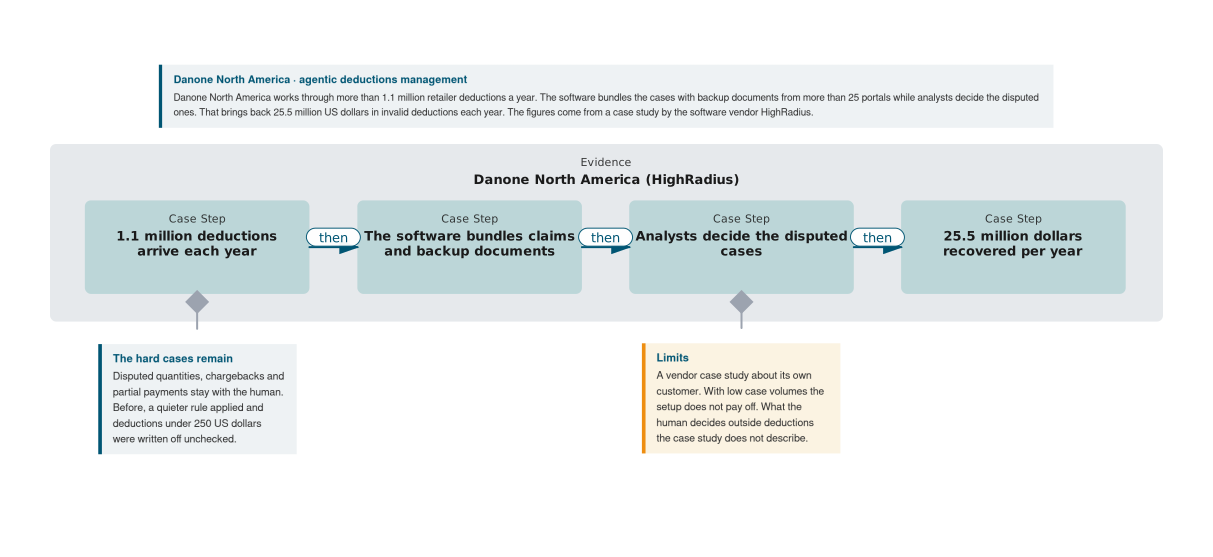
Figure 3: the Danone case. The core of the case is the division of labour, the software gathers the documents and the human decides the disputes. The four boxes show one deduction from arrival to the recovery of the money. The notes below mark which cases stay with the human and where the figures come from.
Autonomous, split: two steps without a human check, at two the law demands a person
The autonomous level of this stream has two sides, because in the middle full automation has run for years while at the beginning and the end the law still demands a person. A payment that the system matches to an invoice affects nobody outside the company, so a wrong match can simply be corrected. An invoice generated from order and delivery follows fixed rules. Suppliers quote hit rates between 85 and 99 percent for automatic matching, measured at their own customers. The rate depends on how many customers put a usable invoice number on their payment. In Switzerland the customer does not have to supply that reference at all, because the QR-bill that replaced the payment slips in October 2022 carries the reference in its code and passes it on with the payment. With an ordinary euro transfer in the SEPA area the customer types the payment reference in by hand, so here the care taken by customers decides the hit rate.
At the front end of the stream the credit decision offers an example of the autonomous level that comes from an annual report to the US securities regulator, a source with no software to sell. The lending platform Upstart arranges consumer loans for more than 100 partner banks and decides with its own learning models. The annual report for 2025 states that 91 percent of the year's nearly 1.5 million loans, with a volume of 11 billion dollars, ran "fully automated, with no human intervention by Upstart". At the initial public offering in December 2020 that share had stood at around 70 percent. The case belongs in Order-to-Cash because every company that delivers on account extends credit. Whether money is paid out or goods are shipped at the end, the creditworthiness check before it is the same.
Control at Upstart sits in the rules that each partner bank sets itself and that the model has to observe with every decision. The report names as hard criteria a minimum credit score, minimum and maximum loan amounts and a ceiling on the debt-to-income ratio, meaning the share of income already committed to loans. The majority of rejections on the platform follow from those criteria set by the banks. Within the rules the model decides, with nobody at Upstart looking at the individual case. The bank that set the rules remains responsible for every one of those decisions, even though it never saw the individual case.
Upstart names the limit of this automation itself in the annual report and draws it at the same point where Post 3 drew it for purchasing, before the money leaves. For car loans and home equity lines of credit the automation reaches only as far as approval, because local requirements and external dependencies demand a human step before the money is paid out, in the report's words "human action prior to funding". The report also discloses a qualification of its own. The metric was widened in the fourth quarter of 2025 to include home equity lines, while the prior years were not restated. The series of 87 percent for 2023, 91 percent for 2024 and 91 percent for 2025 therefore measures two slightly different things, with no material effect on the figures according to the company. The case also comes from American consumer lending. The technique transfers to business between companies, while a different legal framework decides what is permitted there.
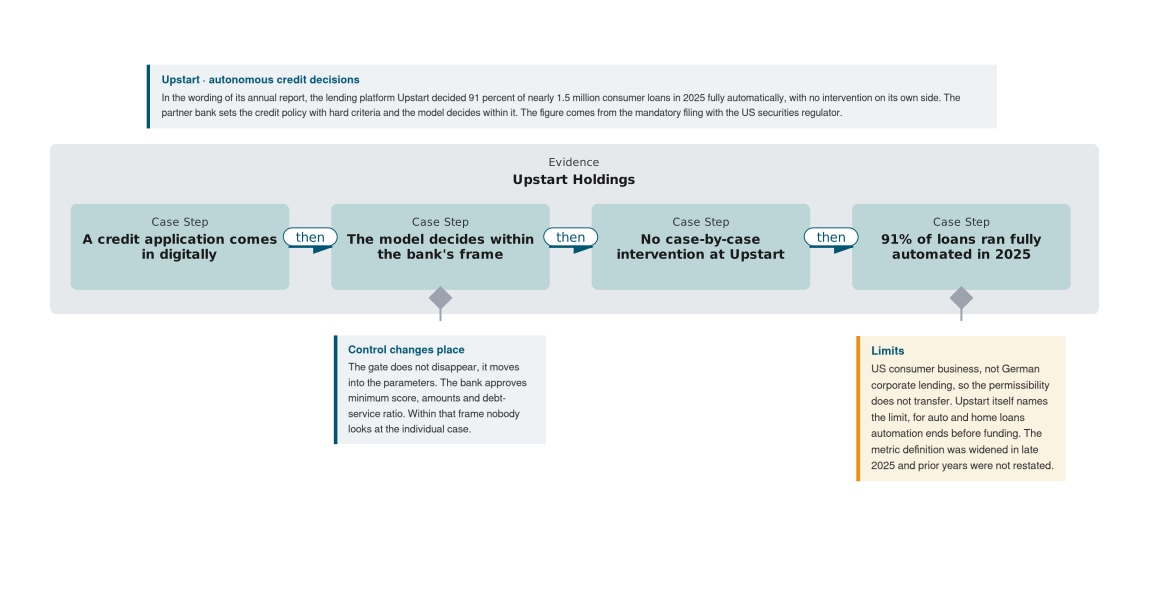
Figure 4: the Upstart case. At this level the bank replaces the review of the individual case with rules it gives the model. The four boxes show one loan application from digital arrival to the automatic decision. The notes below mark who sets the rules and where Upstart itself draws the line.
A court and a regulator settled in 2023 where the limit for private customers in Europe lies today, with no AI involved in either case. In December 2023 the European Court of Justice ruled that a score produced by the German credit agency SCHUFA is itself an automated decision within the meaning of Article 22 of the General Data Protection Regulation, where the contracting party draws strongly on it for its own decision. The narrower reading, under which the agency merely supplies a value and only the contracting party decides, was rejected by the court because it would open a gap in legal protection. Whoever buys scoring buys the decision along with it and cannot pass the responsibility on to the data supplier.
The second case shows what a missing explanation costs, because the Berlin data protection authority let the automated decision stand and penalised only the failure to explain the decision to the customer. On 31 May 2023 the Berlin Commissioner for Data Protection and Freedom of Information fined a bank 300,000 euros for automatically rejecting a customer's online application for a credit card. The customer had a good score and a regular high income, yet received only general information about the procedure and no reasons for his own case, so he could not challenge the decision. The authority found breaches of Articles 22, 5 and 15 of the General Data Protection Regulation. The bank had fixed criteria and rules in place, no AI was involved. The authority does not name the bank and it stays unnamed here as well. For every stream that decides about customers two things follow. The duty to explain does not hang on the technology, because Article 22 speaks of automated decisions and does not mention AI at all. And full automation is permitted, it only becomes expensive once nobody can explain the individual decision.
The legal framework is tightening, because the European Union classifies AI systems for assessing the creditworthiness of private individuals as high risk in its AI Act, with an exception for systems that detect financial fraud. The obligations for those systems were due to apply from 2 August 2026, then in July 2026 the Union moved the start to 2 December 2027. In German law Section 31 of the Federal Data Protection Act governs scoring, which is the section the SCHUFA ruling refers to. The AI Act, the General Data Protection Regulation and Section 31 apply to private individuals, while for business between companies other rules set the limits. The question of how an automatic block is to be explained to a customer of many years arises there just the same.
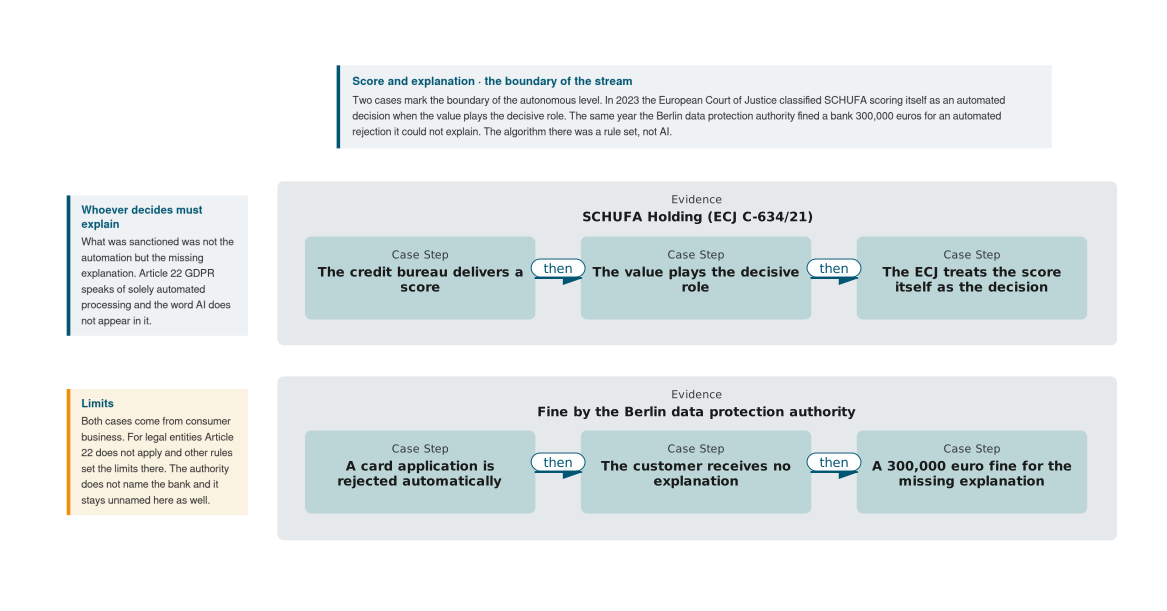
Figure 5: the limit of the stream, two chapters. Two cases from 2023 mark where the autonomous level ends for private customers. Above, the path of a score to the ruling of the European Court of Justice, below the path of a card application to the fine. The notes on the left mark what was penalised and whom both cases apply to.
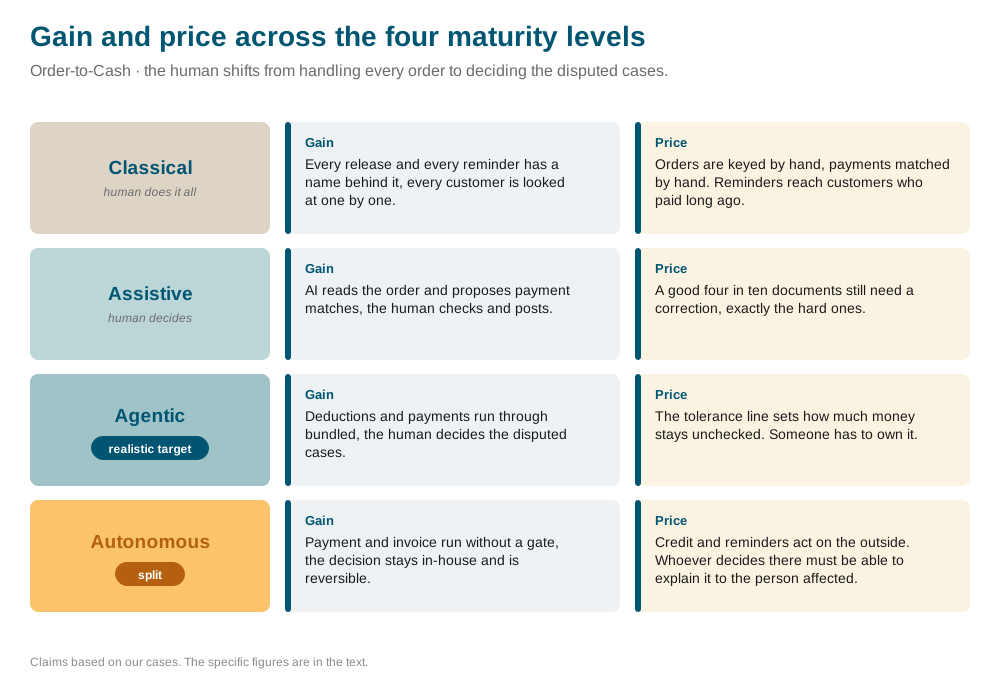
Figure 6: gain and price across the four maturity levels. Every level brings a gain and charges a price, while the price usually goes unmentioned. Read each row as one level, gain on the left, cost on the right. The autonomous row is split, documented and routine in the middle of the stream, limited by law at the ends. A concept drawn from the cases in this post rather than aggregated metrics.
What is realistic
Put the levels side by side and the picture looks similar to purchasing while differing from it at two points. Everything up to and including automatic payment matching is available today, from reading the order and checking it against the master data to gathering the documents for a deduction. Automation brings most where the inputs are clean, on orders in a fixed format, on transfers carrying an invoice number and on deductions with the same reasons every time. It brings little on orders written as running text, on bulk transfers without an invoice number and on individual cases that are in dispute. Those are exactly the transactions that caused most of the work before. They stay with the human now as well.
The first difference from purchasing lies in the preconditions, because part of them sits with the customer rather than inside the company. Clean master data and considered tolerances, meaning defined deviations the system lets through without asking, are the same groundwork as in purchasing. Whether payments arrive with an invoice number and whether orders come in a readable format is decided by the customer. The hit rate of an automation is therefore half a property of the customer base. Anyone who wants to put a figure on the benefit finds three freely visible benchmarks at APQC, a non-profit American organisation for company comparisons. For receipts, collections and deductions together the median cost is 0.94 dollars per 1,000 dollars of revenue. A full-time employee processes a median of 3,333 receipts and costs a median of 82,874 dollars across the whole stream. Anyone who wants to save a million on payment matching needs twelve positions at 82,874 dollars each that did nothing else before.
The second difference sits at the ends of the stream, because there the automation brings with it the duty to explain every rejection and every reminder to the customer. For private customers that has been settled since the SCHUFA ruling and the Berlin fine. A reminder process that leaves the release of every escalation to the human and at the same time puts a hundred cases an hour in front of that human has kept the check in the flow chart and removed it in practice. The number of releases per hour shows whether a human is still checking.
What comes next
Order-to-Cash shows the same pattern as the three streams before it, because the routine work goes to the system, the human looks after the exceptions and at one point a human still checks. The difference from purchasing lies in who demands that check, there the auditor, here the customer with a right to an explanation. That is why the middle of this stream can be automated without risk while the law sets the limit at the ends. The next post takes the same look at Record-to-Report, the stream from the accounting document to the closed books.
Sources
Where a number comes from a party with an interest in the result or is only partly accessible, the entry says so together with the kind of source.
Suntory Beverage & Food Spain, more than 1,000 employees, handling time per order from 2.5 minutes to one minute, 3,400 hours saved in a year, 55.3 percent of orders without correction, close to 600 customers with direct posting, around 3,500 orders a month. Esker, case study, published as a PDF. Written by the software supplier about its own customer.
Matching against master data, warning on unusual quantities, direct posting switched on per customer or channel. Esker, product page on AI-powered order data capture. A supplier's own description.
Danone North America, more than eight billion dollars in revenue, more than 1.1 million deductions a year worth more than 400 million dollars, 25.5 million dollars recovered annually, 25 days shorter resolution, 75 percent more cases per analyst, 527,000 cases assembled automatically, previously 45 days, 35 people, more than 40 hours a week, more than 25 portals, deductions under 250 dollars written off unchecked. HighRadius, case study. Written by the software supplier about its own customer, which by its own account has worked with the supplier for ten years.
Upstart, 91 percent of 1,497,149 loans with 11 billion dollars in volume fully automated in 2025, around 70 percent at the initial public offering in 2020, series 87, 91 and 91 percent for 2023 to 2025, more than 100 partner banks, the banks' hard criteria, limit at car and home loans, change of definition in the fourth quarter of 2025. Upstart Holdings, annual report on Form 10-K for 2025, filed with the US Securities and Exchange Commission, pages 7, 10, 12, 58, 60 and 61. A mandatory filing for whose content the company is liable. The quotations were read at the original for this post.
A score is itself an automated decision where the contracting party draws strongly on it. European Court of Justice, judgment of 7 December 2023 in Case C-634/21, SCHUFA Holding, operative part and paragraphs 48, 54, 61, 63 and 71. Paragraph 71 refers to Section 31 of the German Federal Data Protection Act.
300,000 euro fine for an automated credit card rejection without reasons, breaches of Article 22(3), Article 5(1)(a) and Article 15(1)(h), decision by predefined criteria and rules. Berlin Commissioner for Data Protection and Freedom of Information, press release of 31 May 2023, in German. The authority does not name the bank.
Pressler & Pressler and New Century Financial Services, hundreds of thousands of lawsuits from 2009 to 2014, attorney review usually less than a few minutes and sometimes less than 30 seconds, penalties of one million and 1.5 million dollars. Consumer Financial Protection Bureau, press release of 25 April 2016 with the two consent orders. The findings come from the enforcement proceeding.
Article 22 of the General Data Protection Regulation, decisions based solely on automated processing with legal effect, right to human intervention. EUR-Lex, Regulation (EU) 2016/679, Article 22 together with Articles 5 and 15.
Section 31 of the German Federal Data Protection Act, protection of commerce in scoring and credit reports. Federal Ministry of Justice, current version on gesetze-im-internet.de, in German.
Creditworthiness assessment and credit scoring of natural persons as high risk, exception for the detection of financial fraud, obligations for those systems from 2 December 2027. EUR-Lex, Regulation (EU) 2024/1689 in the consolidated version of 27 July 2026, as amended by Regulation (EU) 2026/1744 of 8 July 2026, Annex III point 5(b) and Article 113(c). The original version set 2 August 2026.
Payment terms 32.21 days, receivables outstanding 40.35 days, overdue invoices settled 8.14 days late, first half of 2026. Creditreform, Zahlungsindikator Deutschland Sommer 2026, press release of 3 August 2026, in German, based on around four million overdue invoice records from around 1.23 million companies. The Creditreform association sells credit reports and debt collection.
Payment periods between companies 60.3 days on average, 52 percent of companies with difficulties caused by late payment, 2024. EU Payment Observatory, Annual Report 2025, prepared by CEPS for the European Commission, published on 16 December 2025, summary and chapter on payment periods. The survey data come from the European Payment Report of Intrum, a debt collection group.
The QR-bill replaced the Swiss payment slips on 1 October 2022, the reference sits in the Swiss QR Code and travels with the payment. SIX, Swiss Payment Standards, page on the QR-bill. SIX is owned by the Swiss banks and runs the scheme.
Median 3,333 receipts processed per full-time employee in accounts receivable, collections and deductions, sample of 2,645 companies. APQC, Open Standards Benchmarking, measure 105927. A non-profit organisation, the median is freely visible while the quartiles are open to members only.
Median 0.94 dollars per 1,000 dollars of revenue for the same three processes, sample of 3,274 companies. APQC, Open Standards Benchmarking, measure 105599.
Median 82,874 dollars total cost per full-time employee across all Order-to-Cash processes, sample of 982 companies. APQC, Open Standards Benchmarking, measure 106169.
Supplier figures, 85 to 99 percent automatic matching of incoming payments. Ranges from product pages and case studies of several receivables software suppliers, without independent verification and marked as supplier figures in the text.
Table of Contents
Upcoming EventsEvents overview
Upcoming Events
Events overview

Services
Resources
All Rights Reserved.