
Vertical Departments, Horizontal Value Stream: Why the Supply Chain Runs Across the Organisation
Why the same departments appear in multiple value streams and what that means for collaboration

Sebastian Bitter
24.6.2026
Companies are organised into departments. The supply chain runs across them. The same departments appear in multiple value streams. Finance, Operations and Sales & Marketing work as network nodes across the supply chain. Silo thinking follows from how organisations are structured, not from culture. S&OP is the mechanism that makes the horizontal connections visible and manageable.
Who Actually Works in the Supply Chain?
In Part 3 we broke the ElbeBräu Hamburg supply chain into three value streams: Sense-to-Plan, Plan-to-Produce and Order-to-Cash. We saw which stages each value stream runs through, which outputs are produced and how the approved S&OP plan acts as the trigger for the entire downstream chain.
One question stayed open: Who does all of this? Which departments work in these value streams? And what happens when we take a closer look?
The answer is more surprising than expected. When we lay the departments onto the value streams, one thing becomes visible: The supply chain does not respect departmental boundaries.
Department by Department
Let us look at three departments more closely. Not abstractly, but concretely: Where exactly do Finance, Operations and Sales & Marketing sit in the ElbeBräu supply chain?
Finance
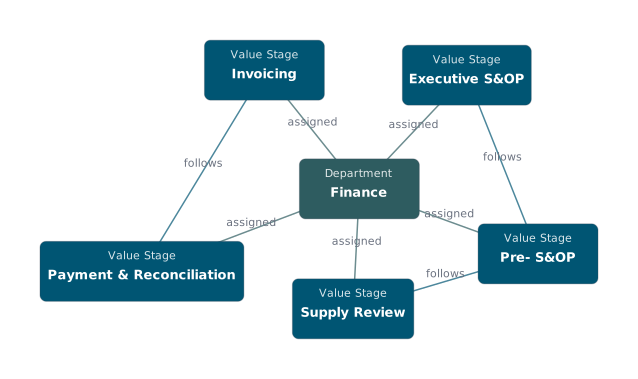
Finance in the Explorer: one click on a department reveals every stage Finance is involved in.
In Metapad's Explorer mode, one click on a node is enough to reveal all its connections. No filtering, no searching, no manual assembly. The model immediately shows where a department appears across the entire supply chain.
Finance appears in five places. In the Supply Review, Finance assesses the financial implications of supply planning. In Pre-S&OP, Finance delivers the numbers for scenario analysis. In Executive S&OP, Finance sits at the table and helps approve the plan. Then Finance skips Plan-to-Produce entirely and only reappears in Order-to-Cash: Invoicing and Payment Reconciliation.
In other words: Finance plans at the start and collects at the end. What happens in between, the entire production, Finance only sees through KPIs. If plan adherence on the shop floor deviates, Finance finds out weeks later in the numbers.
Operations & Manufacturing
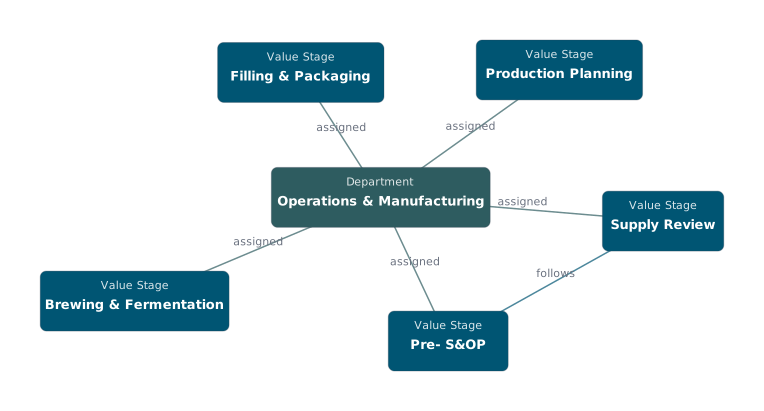
Operations & Manufacturing in the Explorer: from supply planning to filling.
Operations is the department with the broadest reach. In Sense-to-Plan, Operations checks in the Supply Review whether the forecast demand can be covered with the available capacity. In Pre-S&OP, Operations brings the production perspective.
Then Operations moves into Plan-to-Produce: Production Planning, Brewing & Fermentation, Filling & Packaging. That is the jump from "we are planning capacity" to "we are actually producing". No other department bridges this gap between planning layer and physical execution. Operations is the only department that discusses capacity in the S&OP meeting in the same week as standing at the brewing line.
Sales & Marketing
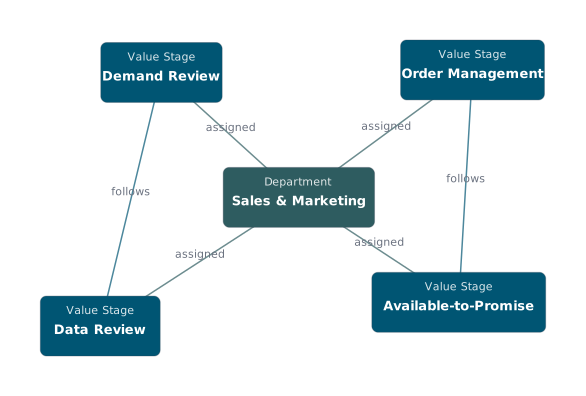
Sales & Marketing in the Explorer: at the start of planning and at the start of execution.
Sales & Marketing has a striking pattern: the department sits at two starting points. In Sense-to-Plan, Sales starts demand planning in the Demand Review. How much Elbe Pils will NordGetränke GmbH order next quarter? In Order-to-Cash, Sales starts the delivery cycle via Order Management and Available-to-Promise.
In between, across the entire production, Sales has no direct touchpoint. Sales gives the impulse at the start. Whatever happens in the brewery, Sales only learns about it when on-time delivery either holds or breaks. That explains a problem many companies know: Sales and production talk past each other because they operate in different worlds.
Two Departments, One Meeting Point
When we turn the perspective one more step and look at two departments at once, the picture becomes even clearer.
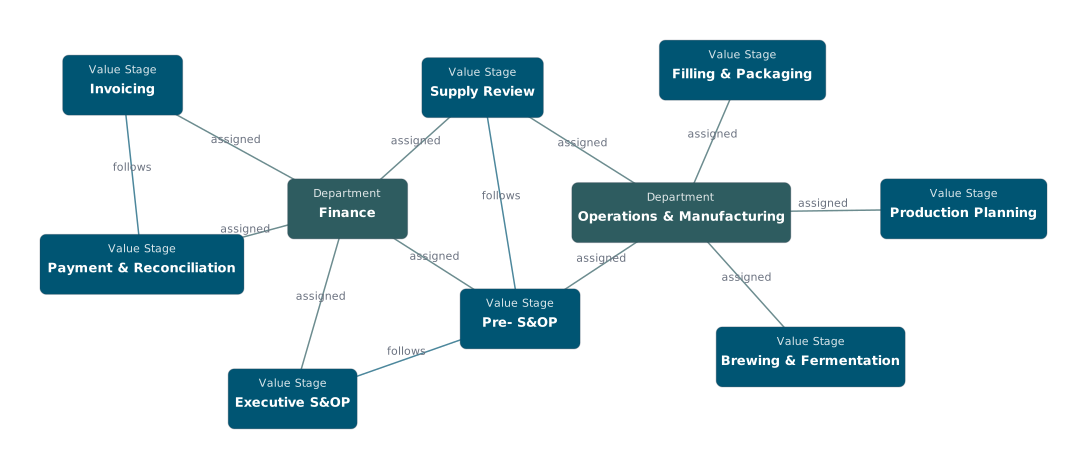
Finance and Operations & Manufacturing in the Explorer at the same time: production on the left, billing on the right, the S&OP cycle in the middle.
Operations sits on the left: Production Planning, Brewing & Fermentation, Filling & Packaging. Finance sits on the right: Invoicing, Payment Reconciliation. In day-to-day work, these two departments operate in completely separate worlds. One brews beer, the other books payments.
In the middle they meet: Supply Review, Pre-S&OP, Executive S&OP. These are the three stages in the S&OP cycle where capacity and finances have to come together. Without this meeting point, Finance would not know what Operations is planning. And Operations would not know which financial constraints apply.
Vertical Organisation, Horizontal Value Stream
The pattern is now clear. Companies organise themselves into departments and for good reason: specialisation, clear accountability, controllability. Finance knows numbers. Operations knows production. Sales knows customers. That is efficient.
But the supply chain runs across this structure. A can of Elbe Pils touches nearly every department in the company on its way from raw material to payment receipt. The organisational structure produces vertical accountability. The value stream requires horizontal collaboration.
This exact tension is what many call "silo thinking". It is a structural problem. The organisation is built that way, regardless of how willing the people are to cooperate. Every department optimises its own slice because it only sees its own slice. Finance optimises cost. Sales optimises revenue. Operations optimises utilisation. All three are right within their own slice and exactly that is why the flow as a whole has no owner.
One Model, Many Perspectives
All the connections we showed in this post are stored in the ElbeBräu Supply Chain Model. They do not need to be researched again every time. One click on a department is enough to reveal every touchpoint across the entire supply chain. What would take hours of research in a PowerPoint deck, the Explorer shows in a second.
We can take it one step further. So far we have only looked at the stages two departments touch. The model can also show what hangs from them.
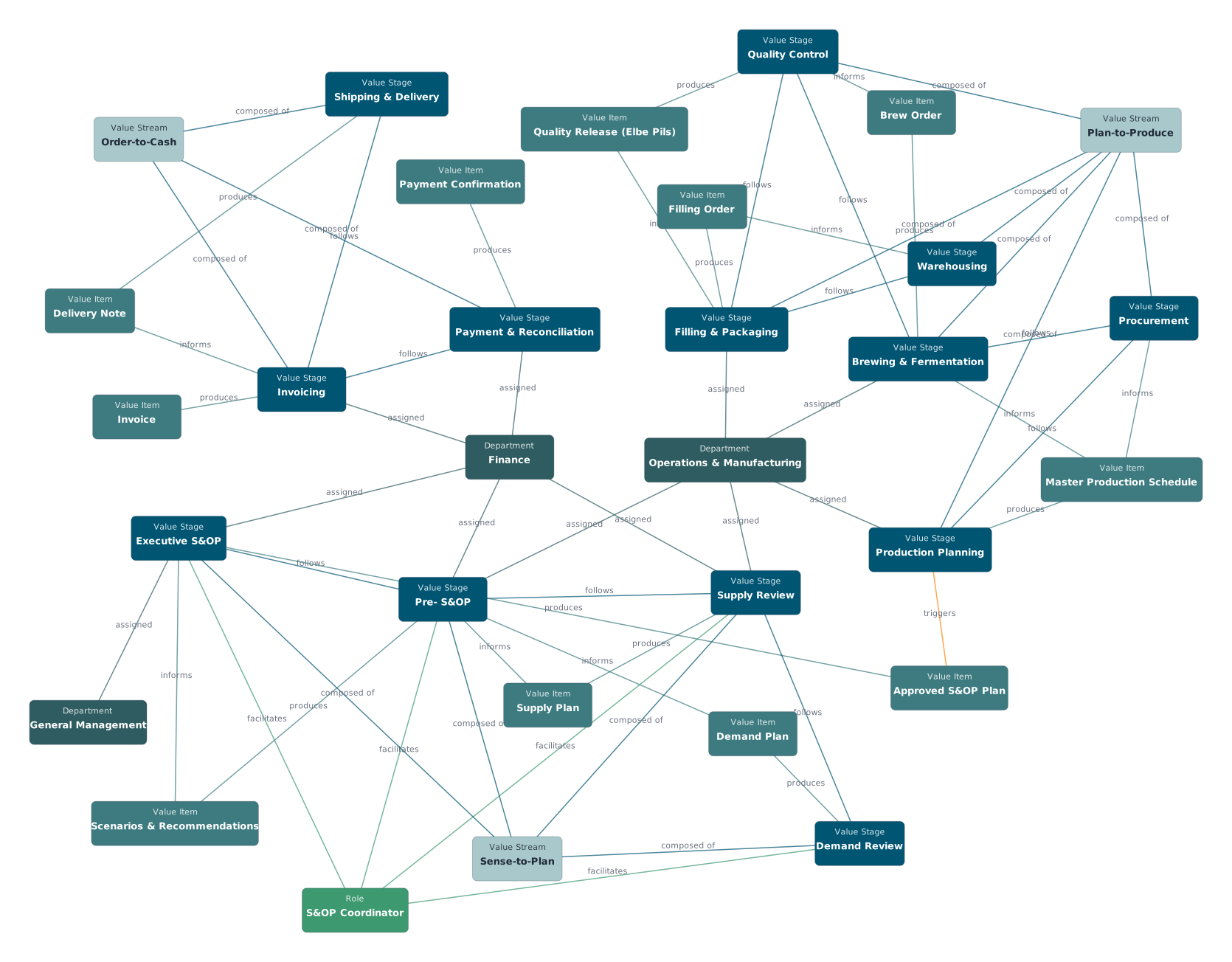
Operations and Finance with all their neighbouring nodes: value stages, value items, other departments, roles and value streams. Two clicks, a near-complete picture of the supply chain.
When the next layer is unfolded, the picture becomes near-complete. Operations and Finance together cover the entire S&OP cycle (Supply Review, Pre-S&OP, Executive S&OP), most of the production line and both ends of the cash flow (Invoicing, Payment & Reconciliation). They produce concrete outputs (Production Plan, Invoice, Payment Confirmation). They work with the S&OP Coordinator and executive leadership. Together they touch all three value streams: Operations across Sense-to-Plan and Plan-to-Produce, Finance across Sense-to-Plan and Order-to-Cash. A simple question ("Where do these two departments sit?") turns into a full picture of how they shape the supply chain.
That is the difference between a static org chart and a navigable model. The org chart shows who reports to whom. The model shows who has to work with whom, which outputs are produced and how everything connects. Once the connections are modelled, every perspective is one click away.
The complexity of a supply chain does not lie in the individual processes. Those are manageable on their own. The complexity lies in the cross-connections between departments. Visible cross-connections can be steered. Hidden ones steer the organisation in the background.
And this is exactly where the circle closes back to S&OP. S&OP is the mechanism that activates these cross-connections. In Executive S&OP, Finance, Operations, Sales and executive leadership sit at the same table at the same time. Sales brings the demand. Operations brings the capacity. Finance brings the numbers. At the end stands a shared decision rather than a compromise between silos. S&OP shifts the optimisation axis from vertical (within each department) to horizontal (across them).
The complete Supply Chain Value Stream Model can be explored in the Metapad Model Library.
What Comes Next
We have now looked at the processes (Part 3) and the organisation (this post). But Sense-to-Plan, Plan-to-Produce and Order-to-Cash are not the only way to decompose a supply chain. Frameworks like SCOR or APQC apply different lenses and highlight different aspects. Where these perspectives overlap, where they complement each other and what that means in practice, that is what the next post is about.
Further Reading: - Try the Interactive S&OP Model - Explore the Supply Chain Model - Play the Beer Distribution

Services
Resources
All Rights Reserved.