
Value Streams and SCOR: Two Lenses on the Same Supply Chain
How the value-stream view and the SCOR reference model overlap, where they set different accents and what each lens brings to the picture

Sebastian Bitter
25.6.2026
Value streams (S2P, P2P, O2C) and SCOR are two established ways to structure a supply chain. They overlap significantly but set different accents. The two lenses line up on the core flow: Plan ≈ S2P, Source + Make ≈ P2P, Deliver ≈ O2C. They do not match one-to-one. That is the instructive part: the differences show where each lens has its strengths. In SCOR terms, S&OP corresponds to the "Plan" process, the one that orchestrates all the others.
Two Ways to Structure a Supply Chain
In the previous posts we looked at the ElbeBräu Hamburg supply chain through a value-stream lens: Sense-to-Plan, Plan-to-Produce and Order-to-Cash. We saw how the processes run, which departments are involved and why S&OP is the most critical lever.
Value streams are one established way to structure a supply chain, rooted in Lean Manufacturing. They organise the chain around end-to-end flows of value, each with a clear start and end. SCOR is another established way. It organises the chain around standardised process categories that any company can recognise itself in.
Both lenses describe the same supply chain. They overlap significantly. They also emphasise different things. This post lays them side by side and shows where they meet, where they diverge and what each one is useful for.
What Is SCOR?
SCOR stands for Supply Chain Operations Reference and was originally developed by the Supply Chain Council. Today it is maintained by ASCM (Association for Supply Chain Management). It is the most widely used reference model for supply chain processes worldwide.
SCOR breaks every supply chain into six core processes:
Plan covers everything related to balancing demand and supply. Demand planning, capacity planning, inventory planning, S&OP. Plan does not sit linearly in the chain. It sits above the others and orchestrates them.
Source covers procurement. Supplier selection, purchase orders, goods receipt, quality inspection of incoming materials. Everything needed to make raw materials and components available.
Make is production. Raw materials are transformed into finished products. Production planning, manufacturing, quality control, packaging.
Deliver spans everything from customer order to delivery. Order management, warehousing, picking, transportation, delivery.
Return covers returns and complaints. Defective goods, return shipments, repairs. In both directions: from the customer back and to the supplier back.
Enable are the cross-cutting functions that keep everything running. IT systems, master data, contract management, compliance, performance management.
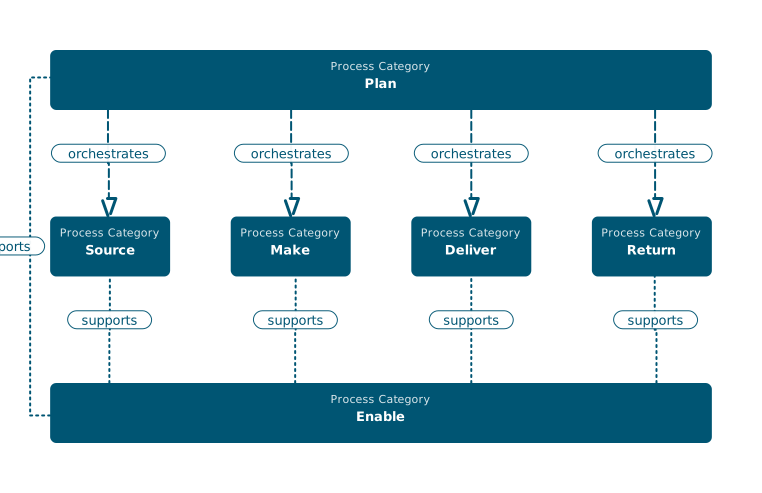
The six SCOR process categories at a glance. Plan sits at the top and orchestrates the executing processes Source, Make, Deliver and Return. Enable sits below as a cross-cutting function that supports all the others.
SCOR's strength lies in standardisation. Every company, whether a brewery, a car manufacturer or a pharmaceutical firm, can fit its supply chain into these six processes. That makes comparison possible and creates a shared vocabulary.
The Mapping: Where the Two Lenses Meet
Place the value-stream view and the SCOR processes side by side and the family resemblance is immediately visible.
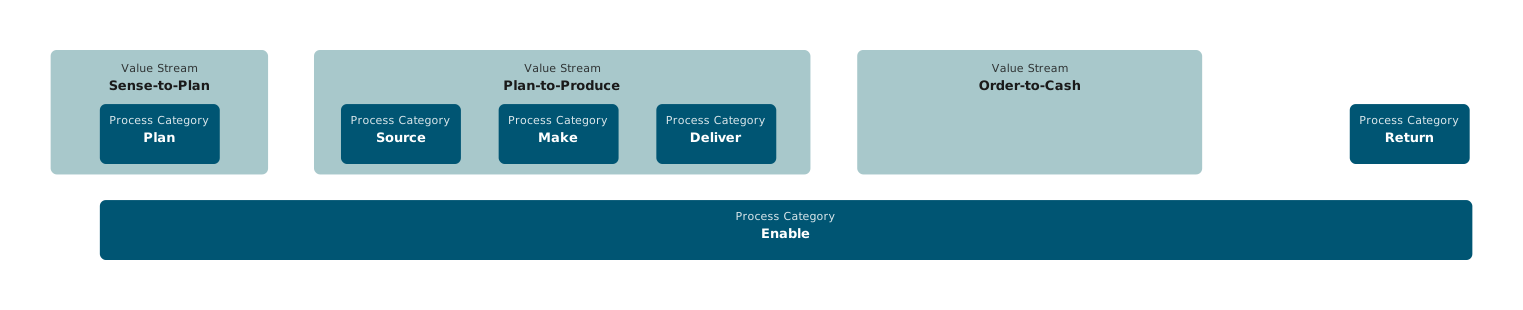
The three ElbeBräu value streams alongside the six SCOR processes. Plan corresponds to Sense-to-Plan, Source and Make correspond to Plan-to-Produce, Deliver corresponds to Order-to-Cash. Return and Enable sit outside the ElbeBräu model by design.
Plan ≈ Sense-to-Plan. The SCOR Plan process covers demand planning, supply planning and the balancing between them. That is exactly what the five S2P stages do: Data Review, Demand Review, Supply Review, Pre-S&OP and Executive S&OP. The overlap is nearly complete.
Source ≈ Procurement. SCOR Source covers procurement and goods receipt. In the value-stream view, that maps to the Procurement stage in Plan-to-Produce. When ElbeBräu orders barley malt from EuroMalt BV and the goods receipt is confirmed, that is SCOR Source.
Make ≈ the production stages. SCOR Make covers physical production. At ElbeBräu, that means Production Planning, Brewing & Fermentation, Quality Control, Filling & Packaging and Warehousing. The Plan-to-Produce value stream therefore bundles Source and Make into one continuous flow.
Deliver ≈ Order-to-Cash (partially). SCOR Deliver covers order management, picking, transportation and delivery. That matches the O2C stages from Order Management through Shipping & Delivery. Order-to-Cash, however, goes further: Invoicing and Payment & Reconciliation are not part of classic SCOR Deliver.
Where the Two Lenses Diverge
The differences are not weaknesses of one approach or the other. They show where each lens emphasises different things and where the ElbeBräu model makes concrete design choices on top of either lens.
Invoicing and Payment. The Order-to-Cash value stream only ends when payment is received. SCOR Deliver ends at delivery. The financial closure of a transaction sits outside the classic SCOR scope. For a brewery that works with a small number of large customers and whose cash flow depends directly on payment behaviour, that last step is too important to leave out. The value-stream view stretches to cover it.
Warehousing. In the ElbeBräu model, warehousing sits at the end of Plan-to-Produce. In SCOR it could equally be argued to belong to Deliver. The choice to place it in P2P is a contextual one: at ElbeBräu, warehousing is physically attached to production. The pallet comes off the filling line straight into the warehouse. Available stock is the result of production, not the start of delivery. A consumer-electronics company with a distribution warehouse far from the factory would draw that line differently.
Order Management and ATP. In the ElbeBräu model, Order Management and Available-to-Promise kick off the O2C value stream. In SCOR, Demand Management (which includes order intake) partly falls under Plan. Both are defensible. SCOR treats the order as the trigger for planning, the value-stream view treats it as the trigger for execution.
These differences make one thing clear: no single lens captures the entire picture. SCOR provides standardised process categories that travel well across industries. The value-stream view organises the same processes around end-to-end flows. The two complement each other.
S&OP in SCOR: Plan as Orchestrator
In SCOR, "Plan" holds a special position. It does not sit linearly in the chain. Plan sits above and orchestrates Source, Make and Deliver. SCOR even distinguishes explicitly between "Plan Supply Chain" (sP1), "Plan Source" (sP2), "Plan Make" (sP3) and "Plan Deliver" (sP4).
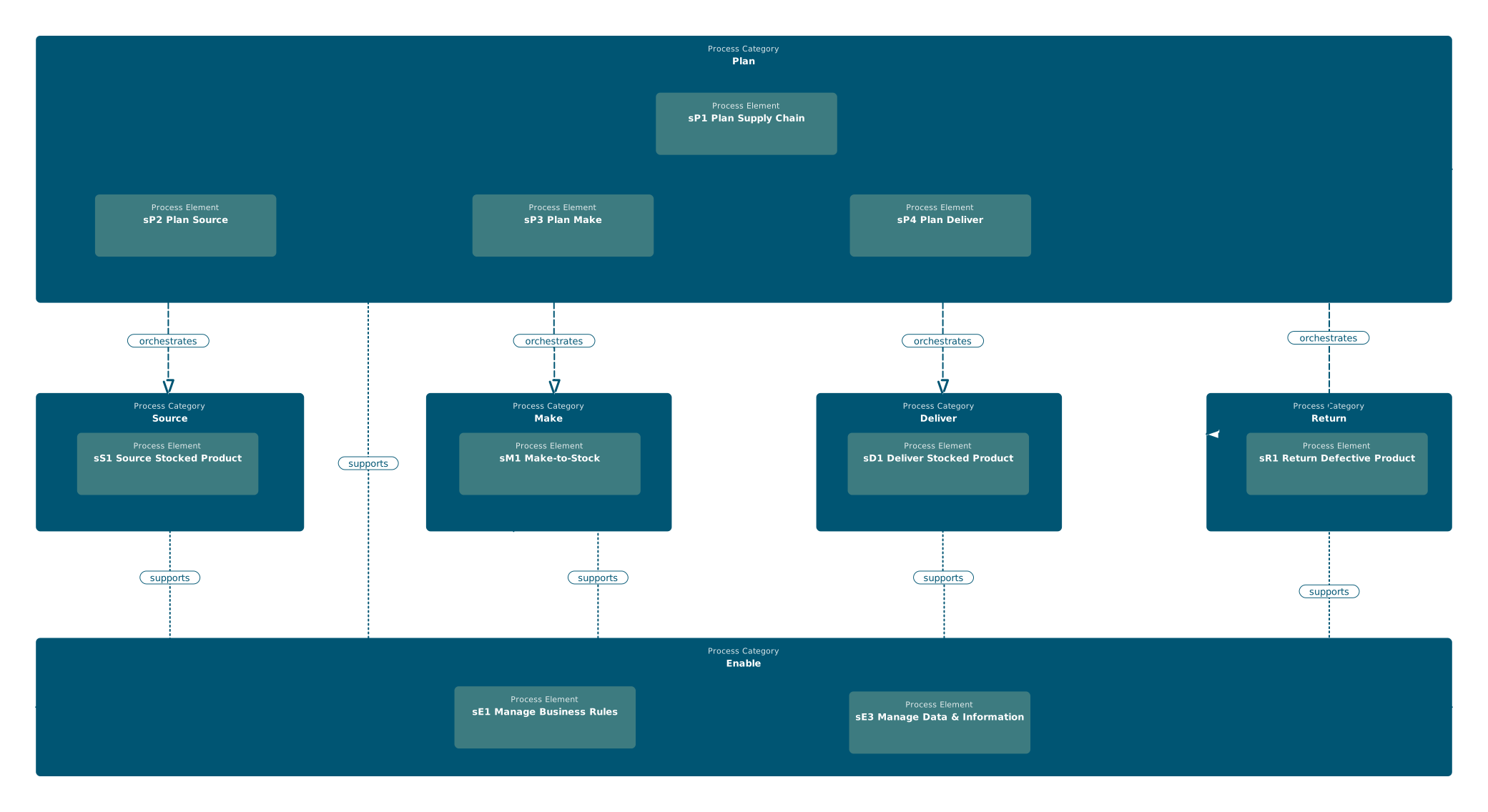
The SCOR Detail View: each Process Category contains specific Process Elements. Plan is the richest, with four sub-processes (sP1 Plan Supply Chain, sP2 Plan Source, sP3 Plan Make, sP4 Plan Deliver) that mirror the executing processes it orchestrates.
That confirms exactly the claim we made in Part 3: S&OP is the central process that steers all the others. In SCOR terminology, Plan influences Source, Make and Deliver. In value-stream terminology, Sense-to-Plan influences Plan-to-Produce and Order-to-Cash. Same logic, two vocabularies.
The causal chain from Part 3 translates directly into SCOR language: forecast accuracy in Plan determines plan adherence in Make, which in turn determines on-time delivery in Deliver. The mechanics are the same, no matter which lens you use to read them.
What SCOR Adds: Return and Enable
Two SCOR processes sit outside the ElbeBräu value-stream model: Return and Enable. That is intentional. SCOR brings a perspective here that the value-stream view does not foreground.
Return (returns and complaints) was left out of the ElbeBräu model by design. ElbeBräu is a simplified brewery, and returns play a minor role in beverage wholesale. For a company with a high return rate (e-commerce, electronics), Return would deserve its own value stream: Return-to-Refund or Return-to-Restock. SCOR makes this dimension visible by default; the value-stream view leaves it to the modeller.
Enable (cross-cutting functions) is the second one. IT systems, master data management, compliance and performance management are real and important, but they are not value streams in the strict sense. They enable the value streams rather than being one. SCOR carves out a category for them; the value-stream view treats them as infrastructure. In a future extension of the ElbeBräu model, a Technology Layer could make them explicit. The basic structure in the metamodel is already prepared for it.
What This Means in Practice
Laying the two lenses side by side yields three insights that matter in day-to-day consulting.
First: SCOR is a shared language. When a company describes its internal processes in SCOR terms, any experienced supply chain consultant can jump in immediately. That saves time and prevents misunderstandings. Even when the ElbeBräu model is built around value streams, the SCOR vocabulary helps when we work with other companies, tools or external consultants.
Second: The mapping makes design decisions visible. Placing warehousing in Plan-to-Produce instead of Deliver, or stretching O2C to cover invoicing and payment, are deliberate choices with consequences. Holding the value-stream view against the SCOR categories forces those choices to be named rather than hidden. Every divergence from a category is a statement about how a company sees its own work.
Third: What is not in the model matters as much as what is. ElbeBräu has no explicit Return process because returns are minor for a brewery. ElbeBräu has no Enable layer because the focus is on value streams rather than cross-cutting functions. These are not gaps, they are scoping decisions. The comparison with SCOR is what makes those decisions explicit.
The ElbeBräu Supply Chain Model with the SCOR mapping can be explored in the Metapad Model Library.
What Comes Next
So far we have looked at the supply chain from different angles: planning, disruptions, value streams, departments and the SCOR framework. The picture is now fairly complete on the conceptual side. The next post turns the picture into action. How do we actually start an S&OP process, given everything we have seen so far? Where does a team begin, which steps come first, and what are the typical traps along the way. The closing post in this series puts the theory back on the floor.
Further Reading: - Try the Interactive S&OP Model - Explore the Supply Chain Model - Play the Beer Distribution Game
Services
Resources
All Rights Reserved.