Re-Think Your Operating Model with AI
Workshop
A full day on your operating model, with your real documents and your people in the room. We build a computational knowledge graph of how your enterprise actually runs — strategy, operations and measurement in one connected, queryable model — and leave you with a ranked list of what to fix first.
Many enterprises run on operating models that live in tacit knowledge, scattered documents, and the heads of senior people.
The strategy is in a board deck, the processes in a write-up nobody has opened in two years, the KPIs in a monthly spreadsheet, the initiatives in a programme plan. Each is internally consistent and mutually disconnected — so no one can answer a simple question like "which step is the real drag on our delivery times, and which initiative actually fixes it?" without reconciling three documents by hand.
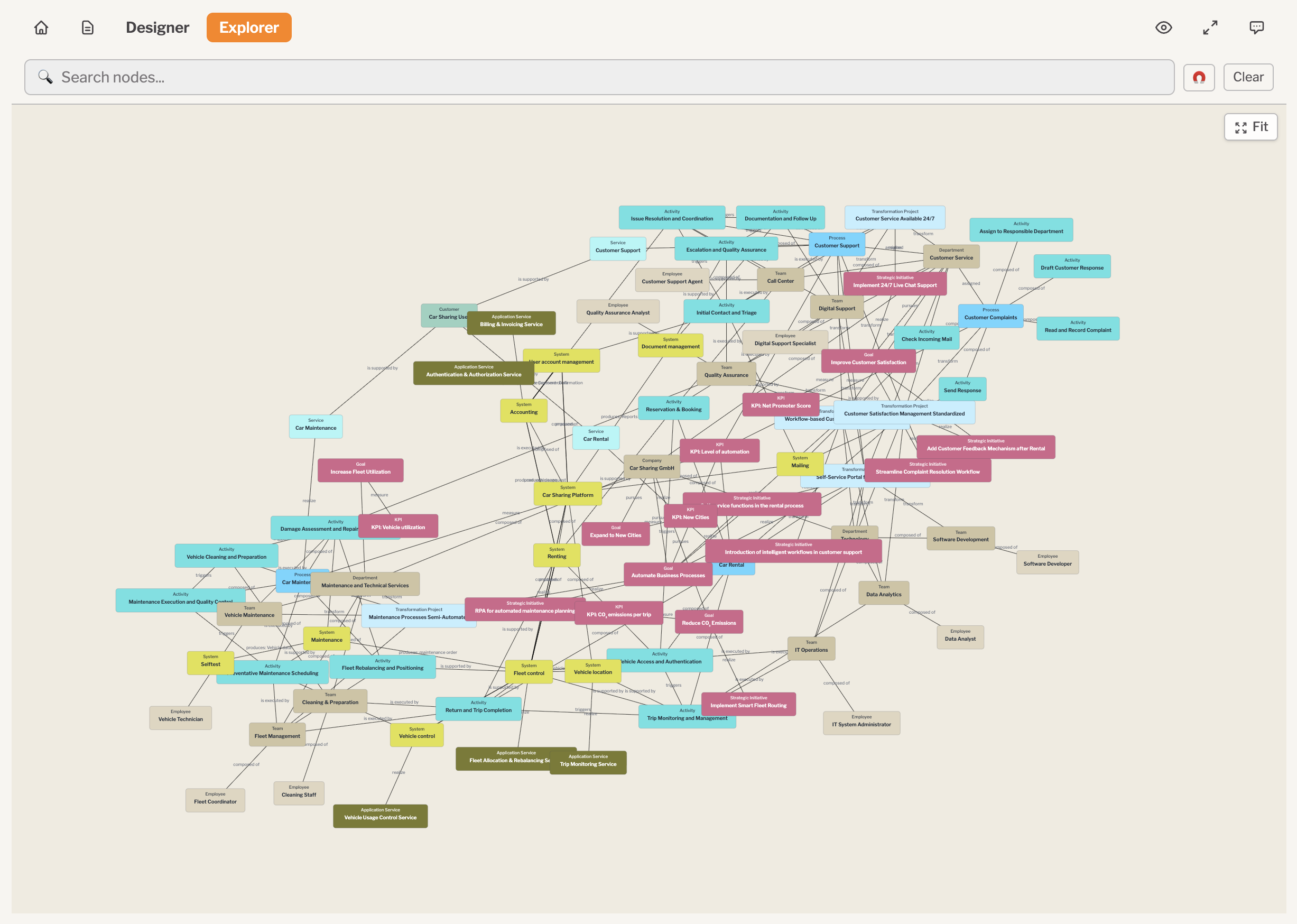
This workshop closes that gap in a day. Working from the ordinary documents you already have, we build a typed knowledge graph of your operating model — live, with AI doing the heavy lifting and your people steering — until you can ask it questions and get answers you can trace, challenge, and re-run.
If you saw our Re-Think Your Operating Model - Live, with AI webinar, this is the natural next step: the same workflow you watched on a fictitious company, now on yours, with a full day to go deep (if not: you can download the recording and slidedeck here).
What we do in the day
- Frame the question (morning). We start by agreeing the one or two decisions you actually want the model to inform — doubling throughput, cutting cycle time, standing up a transformation, scoping where to automate. That keeps the build pointed at value, not completeness.
- Build the three layers. From your real artefacts — a leadership memo, a process write-up, a KPI snapshot, a strategy note — we build the model layer by layer, with AI as a co-modeller:
- Strategy — your goals and the initiatives meant to deliver them.
- Operations — your processes and the individual activities that make them up, each carrying real attributes: execution type, handling time, volume, error rate.
- Measurement — your KPIs, wired back to the goals they measure and the activities that drive them.
- Interrogate the model (afternoon). We put your decision questions to the model you just built —which steps are the biggest drag? what should we fix first? which initiative fixes which problem? — and trace the answers from goal down to activity and back.
- Surface the gaps. Crucially, the model tells you what it is least sure about — where your documents contradict each other or leave a gap. Those gaps become the agenda for the real transformation.
We don't impose a template. We don't tell the AI what your operating model "should" look like — we let the structure emerge from your own documents and your own language. The model stays honest to your enterprise, not to a framework.
What to bring
- The ordinary documents you already have: strategy slides, process write-ups, an org chart, a KPI sheet, a programme plan. Messy and incomplete is fine — that's the point.
- The one or two decisions you'd most like a model of your operating model to inform.
- The people who hold the knowledge — the operations lead, the process owners, the transformation owner. The model is only as good as the room.
What you'll take away
- A working computational knowledge graph of your operating model — strategy, operations and measurement in one connected, typed model you can keep using and extend.
- A ranked list of what to fix first — the activities that are the biggest drag on your priority KPIs, tied to the initiatives meant to address them.
- A clear map of the gaps a real transformation needs to close — the contradictions and unknowns the build surfaced.
- A first-hand feel for the workflow — so your own people can keep the model alive after we leave.
Who it's for
- Operating Model Owners — CEOs, COOs, CTOs and other senior leaders accountable for how the enterprise actually runs, who want their operating model to be a queryable, improvable artefact rather than tacit knowledge spread across people and slide decks.-
- Transformation Owners — accountable for a specific multi-stakeholder transformation, who need the model of the work to stay explicit and useful as the programme evolves.
- Modelling practitioners — enterprise architects, business engineers, knowledge engineers and operations researchers who'll keep the model alive once it's built.
Why a model, not another deck
This isn't an AI summarising your documents. A chatbot pointed at your files retrieves text and returns a plausible paragraph — it cannot tell you which step drives which KPI, because that relationship never existed in any single document until you connected it.
A computational knowledge graph gives you one shared, reliable view — for people and for AI. Everything else — the speed, the trust, the ability to change a number and re-run — falls out of having a typed model instead of a pile of documents.
See it in practice: explore the worked-example model we built live during the webinar — a wholesale distributor's operating model, built from blank canvas to a connected model of 34 nodes in about thirty minutes.
Practical
- Duration: 1 full day (on-site or virtual)
- Format: In-house — your operating model, your documents, your people
- Platform: We build in Metapad, our platform for collaborative, AI-powered enterprise digital twins; you keep the model
- Next step: a short scoping call to agree the focus, the documents, and the room
Recent BlogpostsGo to blog overview
Recent Blogposts
Go to blog overview
Services
Resources
All Rights Reserved.