
Starting S&OP: The First Ninety Days
Where to begin, which maturity stages to climb and which common traps to avoid before the process is established

Sebastian Bitter
29.6.2026
Across six posts of this series we worked from why S&OP matters through how it sits in the organisation. This closing post turns the picture into action: how does a team actually start an S&OP process? The Oliver Wight maturity model gives a self-check on where the organisation stands. The minimal viable S&OP describes the smallest cycle that proves the mechanics work. Five common pitfalls explain why initiatives stall, all of them organisational rather than technical. The ElbeBräu simulator offers a risk-free environment to rehearse the dynamics before the first real meeting.
What We Have Learned So Far
Across the first five posts of this series we looked at the supply chain through different lenses:
Post | Lens | Key insight |
1 | The Planning Matters More Than the Plan | The S&OP process matters more than any single forecast |
2 | When the Plan Falls Apart | Disruptions reveal the limits of every strategy; robustness beats precision |
3 | S&OP Is Not a Silo | Three value streams (Sense-to-Plan, Plan-to-Produce, Order-to-Cash) carry the work |
4 | Vertical Departments, Horizontal Value Stream | S&OP cuts across departments; silos are a structural problem |
5 | Value Streams and SCOR | Two established lenses on the same supply chain, with overlapping coverage |
The picture is now reasonably complete on the conceptual side. We know what S&OP is, where it lives in the organisation and how it relates to established frameworks. One question remains: how does a team actually start an S&OP process, given everything we have seen?
This post closes the series. It looks at where an organisation typically stands today, what the first realistic step looks like and which traps catch most teams along the way. It also positions the ElbeBräu simulator as a safe practice ground before the first real meeting.
Where Do You Stand? Five Stages of S&OP Maturity
Before designing the first month, it helps to know where an organisation stands today. The Oliver Wight maturity model has become the standard reference, with five stages from Foundation to Integrated. Each stage describes a typical state rather than a target. Most organisations sit somewhere between Stage 1 and Stage 2.
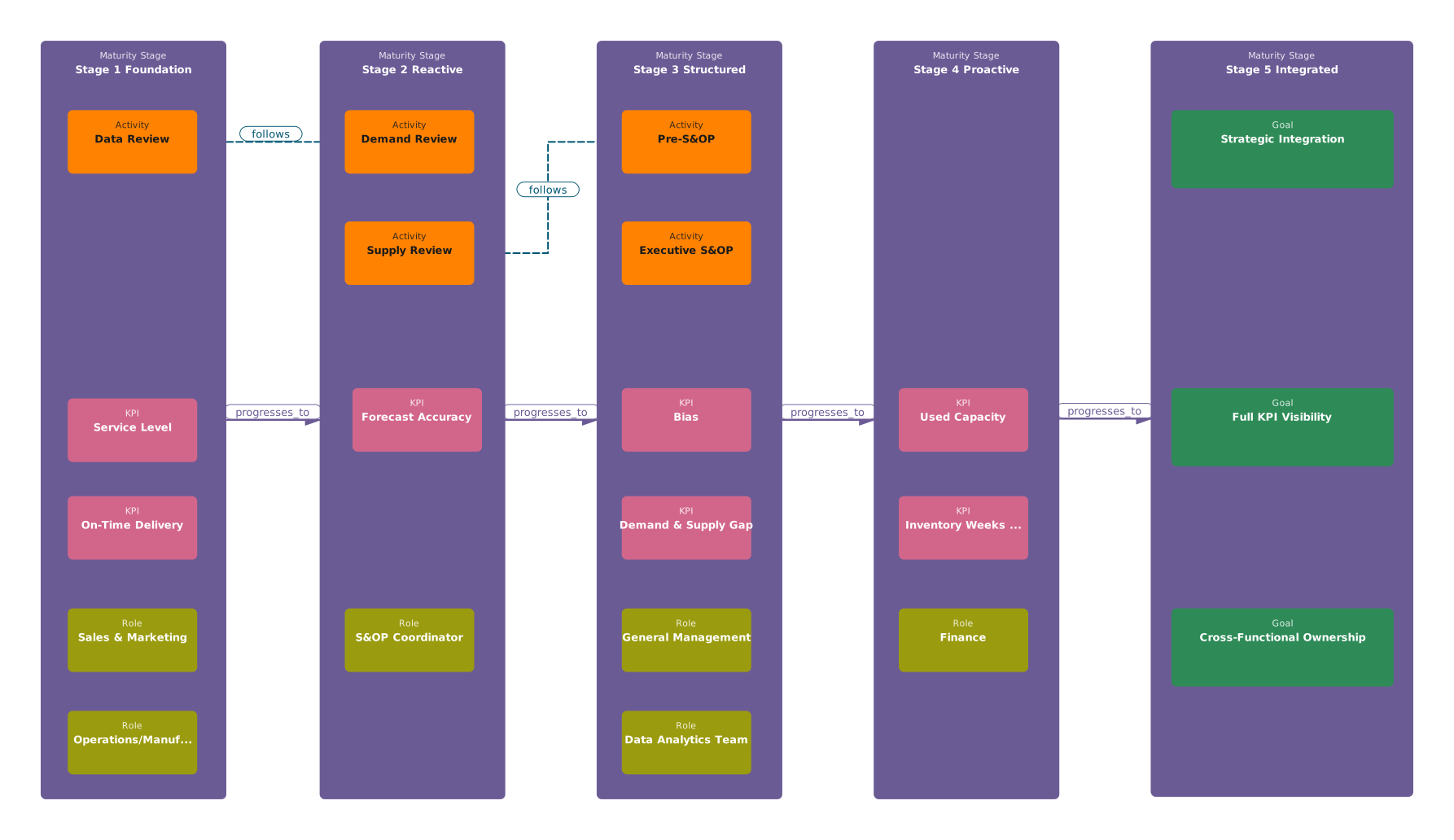
Source: Oliver Wight ABCD Checklist for Operational Excellence; Wallace and Stahl, "Sales & Operations Planning: The Self-Audit Workbook."
Stage 1: Foundation. Demand and supply planning happen in isolation. Sales builds a forecast, production plans capacity and the two only meet when something breaks. The dominant KPI is delivery service to the customer. The most common symptom is firefighting at month-end.
Stage 2: Reactive. A monthly meeting exists. People show up, numbers are discussed, and the decisions made there often dissolve before the next cycle. Forecast accuracy is tracked, often as the only KPI. The dominant pattern is post-mortem on last month rather than commitment for next month.
Stage 3: Structured. The S&OP cycle runs on a predictable cadence. Roles are defined (S&OP coordinator, executive sponsor). Decisions are documented and tracked across cycles. Forecast bias is monitored alongside accuracy. The visible improvement is fewer last-minute escalations.
Stage 4: Proactive. Scenarios become part of the routine. Demand-supply gaps are spotted three or four months ahead rather than in the month of impact. Finance sits at the table and translates capacity decisions into cash-flow consequences. The visible improvement is more deliberate inventory positioning.
Stage 5: Integrated. S&OP merges with strategic planning. The same cycle drives both the operational rhythm and the longer-term capacity decisions. Outcomes are measured across financial, customer and operational dimensions. The visible state is alignment without escalation.
The model is descriptive, not prescriptive. Real organisations rarely sit cleanly in one stage. A team may have Stage 3 process discipline alongside Stage 1 data quality. The model is useful as a self-check rather than as a stamp.
Where to Start: The Minimal Viable S&OP
Whatever the current stage, the first move is the same. Run a small, complete cycle once and learn from it. The first ninety days have one purpose: to prove that the mechanics work for one product group with one team. Company-wide rollout comes later.
The four ingredients
A minimal viable S&OP needs four things, no more:
- One product group. Not the whole portfolio. The one that hurts most when stockouts happen, or the one with the cleanest historical data.
- One monthly meeting. Sixty minutes, fixed in the calendar, same week every month.
- Three people. Sales, operations and one moderator who runs the meeting and tracks decisions.
- One number. Forecast versus actual. Start with this single comparison. More metrics can come later.
Source: Wallace and Stahl, "Sales & Operations Planning: The How-To Handbook" (3rd ed.).
The first ninety days
A pragmatic phasing from the same source:
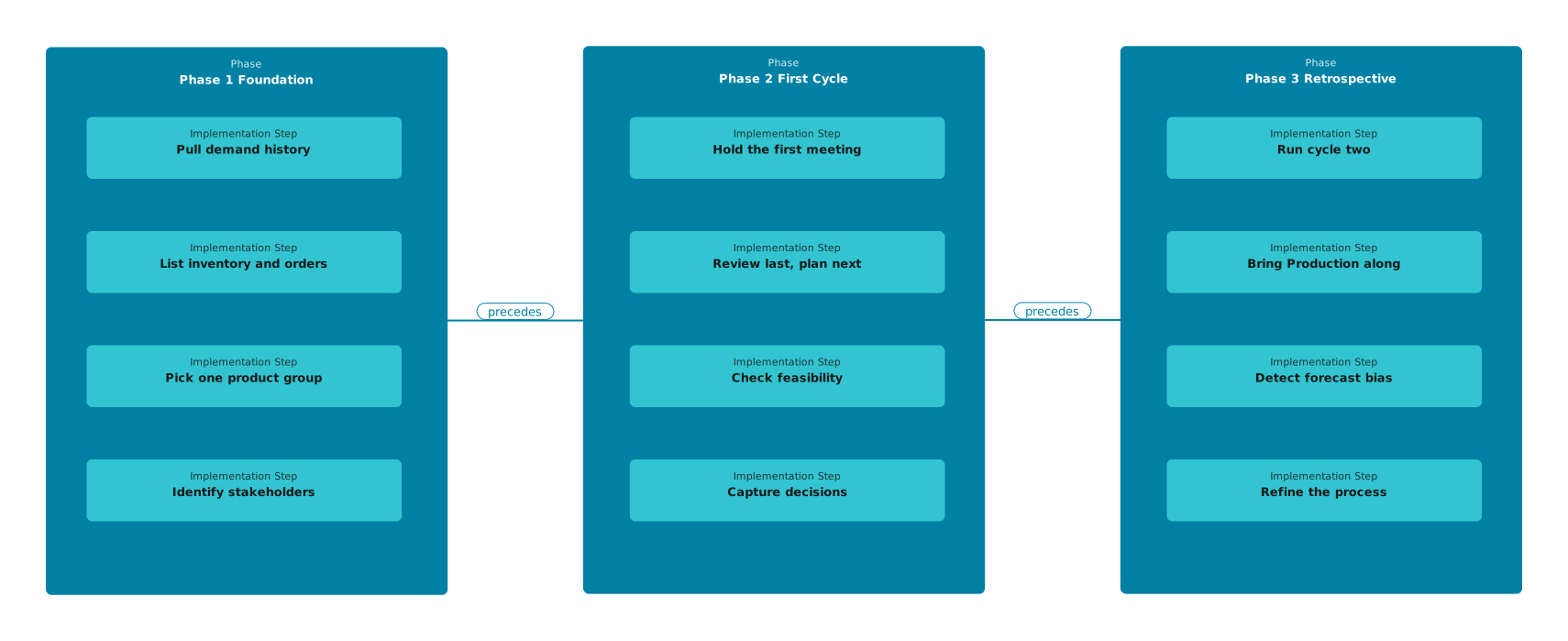
Weeks 1 to 4: get the data on the table. Pull twelve months of sales history and twelve months of forecast (where it exists). List current inventory and open production orders. Pick the product group. A clear baseline matters more than perfect data.
Weeks 5 to 8: run the first cycle. Hold the first meeting with a four-part agenda. Review what happened last month. Look forward to what is expected next quarter. Check feasibility (can the plan be delivered). Decide what changes, who does it, by when. Sixty minutes total. The moderator writes everything down.
Weeks 9 to 12: retrospective and adjust. What worked, what did not, what changes for cycle two. The typical learnings: data needs to arrive earlier, production needs to be present and not just informed, the forecast carries a systematic bias.
Three cycles establish whether the mechanics work; they do not yet add up to a complete S&OP process. The next ninety days extend the scope.
Common Pitfalls
Five recurring patterns explain why S&OP initiatives stall. All five are documented in the literature; all are organisational rather than technical.
Sources: Oliver Wight maturity model; APICS S&OP body of knowledge; Gartner S&OP Maturity Curve research notes.
# | Pitfall | Setup | Result | Better |
1 | Starting too complex | "Let us roll out S&OP across all 500 products and 12 regions." | The project sinks under its own weight. | Pilot with one product group and one region. Learn, then scale. |
2 | No clear ownership | "S&OP is important. All of us own it together." | When everyone is responsible, nobody is. | One person drives the process. Reliability beats title. |
3 | Forecast as the scapegoat | "The forecast was wrong again. Sales has no idea." | Blame replaces learning. Attendance drops. | Treat the forecast as a discussion starter. The gap is the lesson. |
4 | Meetings without consequences | "We agreed last month that we need more buffer." (Then nothing.) | S&OP becomes a coffee meeting. | Every meeting ends with a written decision list. Each decision has an owner and a due date. |
5 | Tool before process | "Let us buy a 200,000-Euro S&OP platform first." | A bad process runs faster but remains bad. | Run the process on a spreadsheet for six months first. Then a tool can amplify the working pattern. |
The ElbeBräu Simulator as a Learning Tool
The simulator we have used throughout this series is also a practice ground. Before the first real S&OP meeting, a team can rehearse the mechanics in a safe environment.
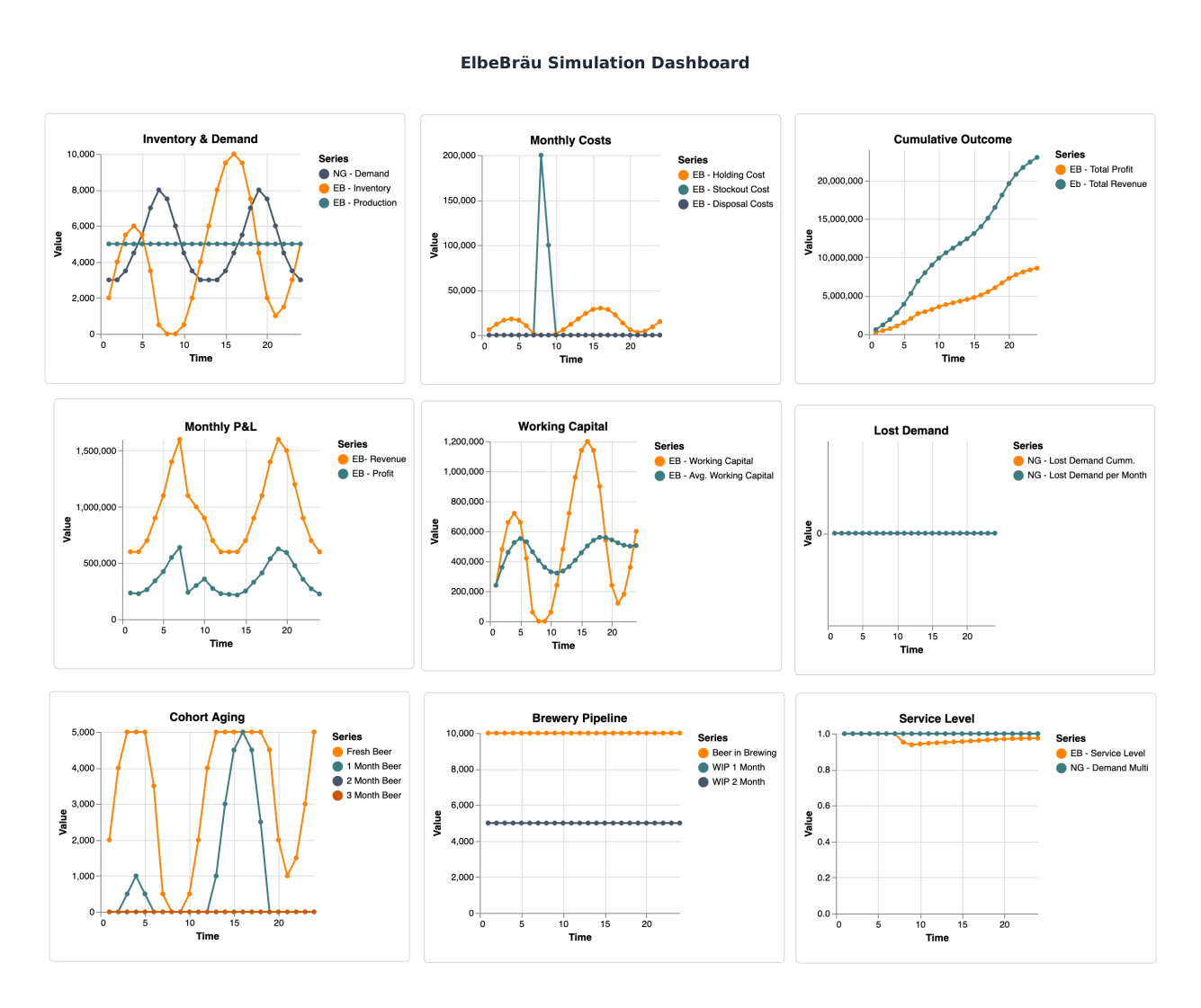
The interactive S&OP model lets a team explore three questions without organisational risk.
How does forecast bias play out over time? Set the bias slider to plus or minus 15 percent and run the model. Watch how a systematic over- or underestimate builds up in inventory or stockouts. The lesson: the direction of the bias matters more than the magnitude.
How do disruptions test a strategy? Pick a disruption (material shortage, capacity blocked, logistics strike) and compare how the five order strategies cope. The lesson: robustness is rarely the same as optimality.
Where is the trade-off between holding cost and stockout cost? Move the target inventory slider and watch the cumulative profit curve. The lesson: the cheapest answer is usually wrong at the edges.
Each of these exercises mirrors a real S&OP question without putting an organisation at stake. A team that has played through them once enters the first real meeting with shared vocabulary and shared intuition.
Closing the Series
Across six posts we worked from why S&OP matters, through how it is structured, where it lives in the organisation, how it sits next to other frameworks and finally how a team starts the process. The thread holding everything together is the ElbeBräu showcase. Every concept from the series can be experienced in the model.
S&OP is less a project than a practice. The first month produces an imperfect cycle, the third a better one, the twelfth a different conversation between departments than what existed before. The model shows the mechanics; the organisation does the work.
For teams that want to take the next step beyond reading, we will offer a hands-on workshop in autumn that builds on the same simulator. More on that as it shapes up.
The complete ElbeBräu showcase is available in the Metapad Model Library.
Further Reading: - Try the Interactive S&OP Model - Play the Beer Distribution Game

Services
Resources
All Rights Reserved.